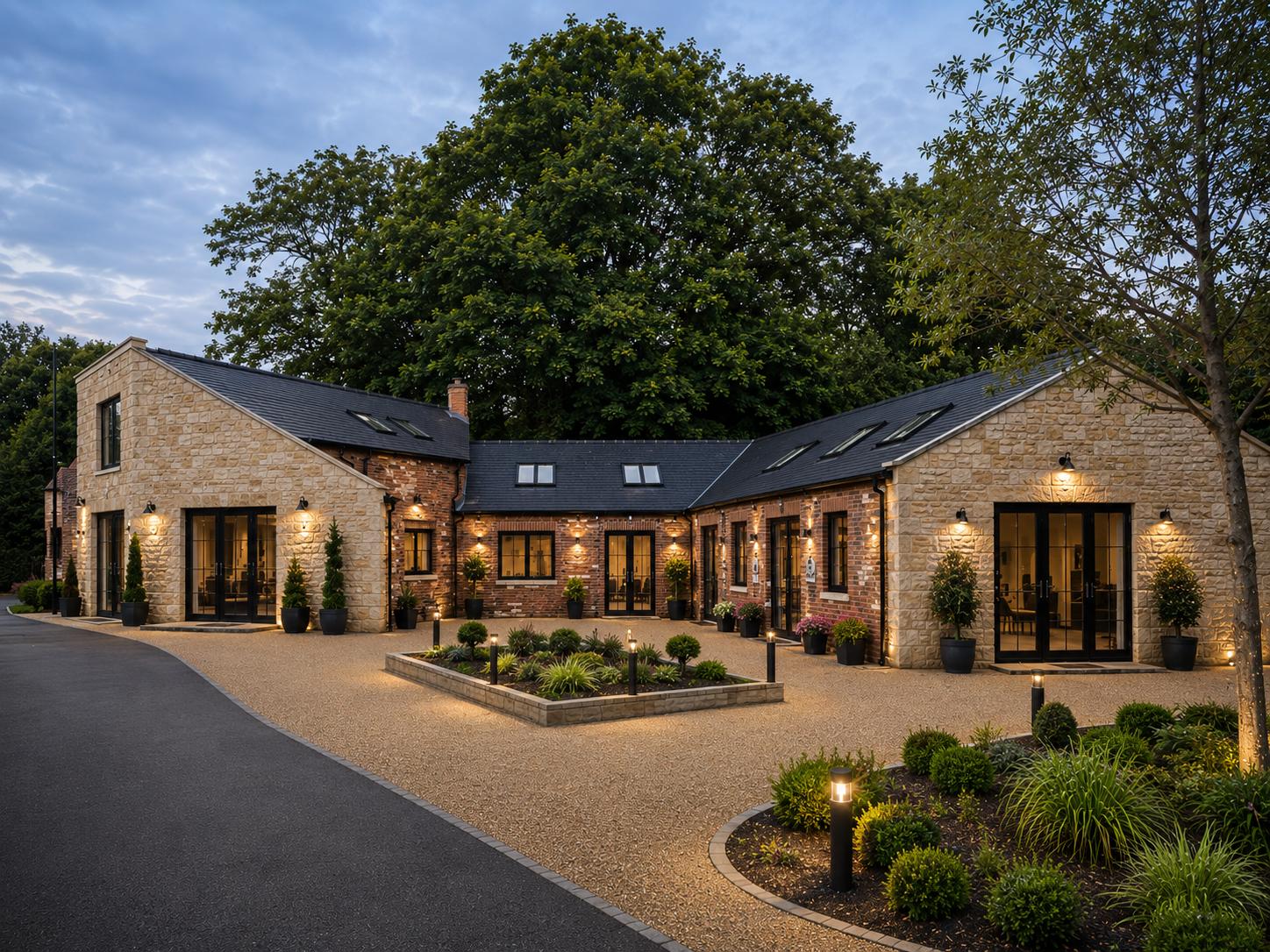
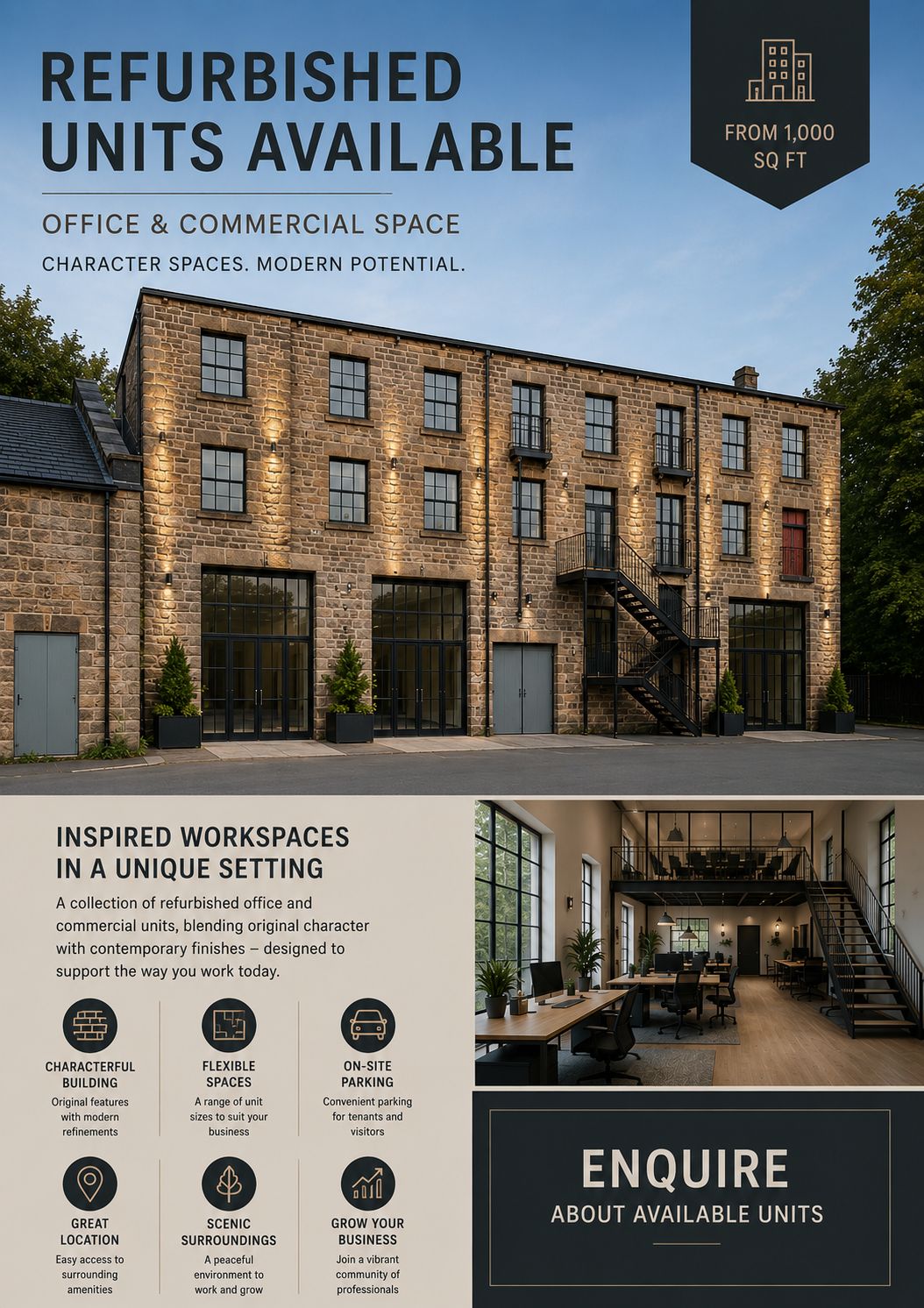
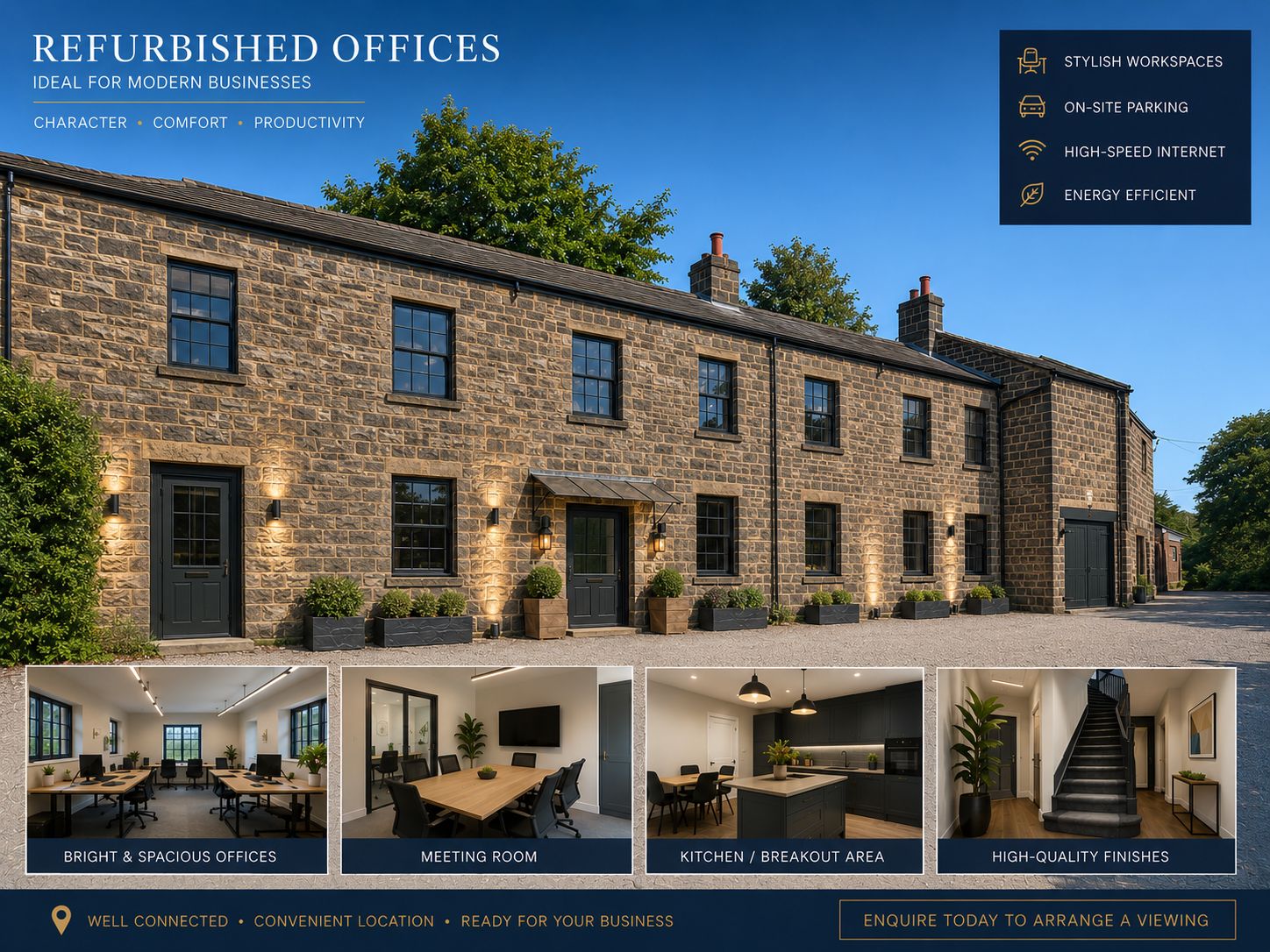
Abbey Mills is a Grade II listed former corn, oil and woollen mill (National Heritage List entry 1256706), part of the historic group around Kirkstall Abbey. Its story shapes everything about the restoration.
Medieval — Monks of Kirkstall Abbey cut the goit (mill race) to serve their corn mill on this site.
1799 — Fire destroys the earlier buildings; scorched stones are reused in the rebuild.
1820s — The present complex rises; Ephraim Elsworth works a corn & oil mill, with woollen cloth produced alongside. One western-range stone is dated 1814.
1820s–1961 — Woollen cloth production continues for well over a century.
1961/62 — Acquired by Leeds City Council and sub-divided into light-industrial units let to commercial tenants.
2011 — The main mill buildings fall largely vacant.
2023 — Freehold sold at auction; restoration and direct letting begin.
1Origins & construction
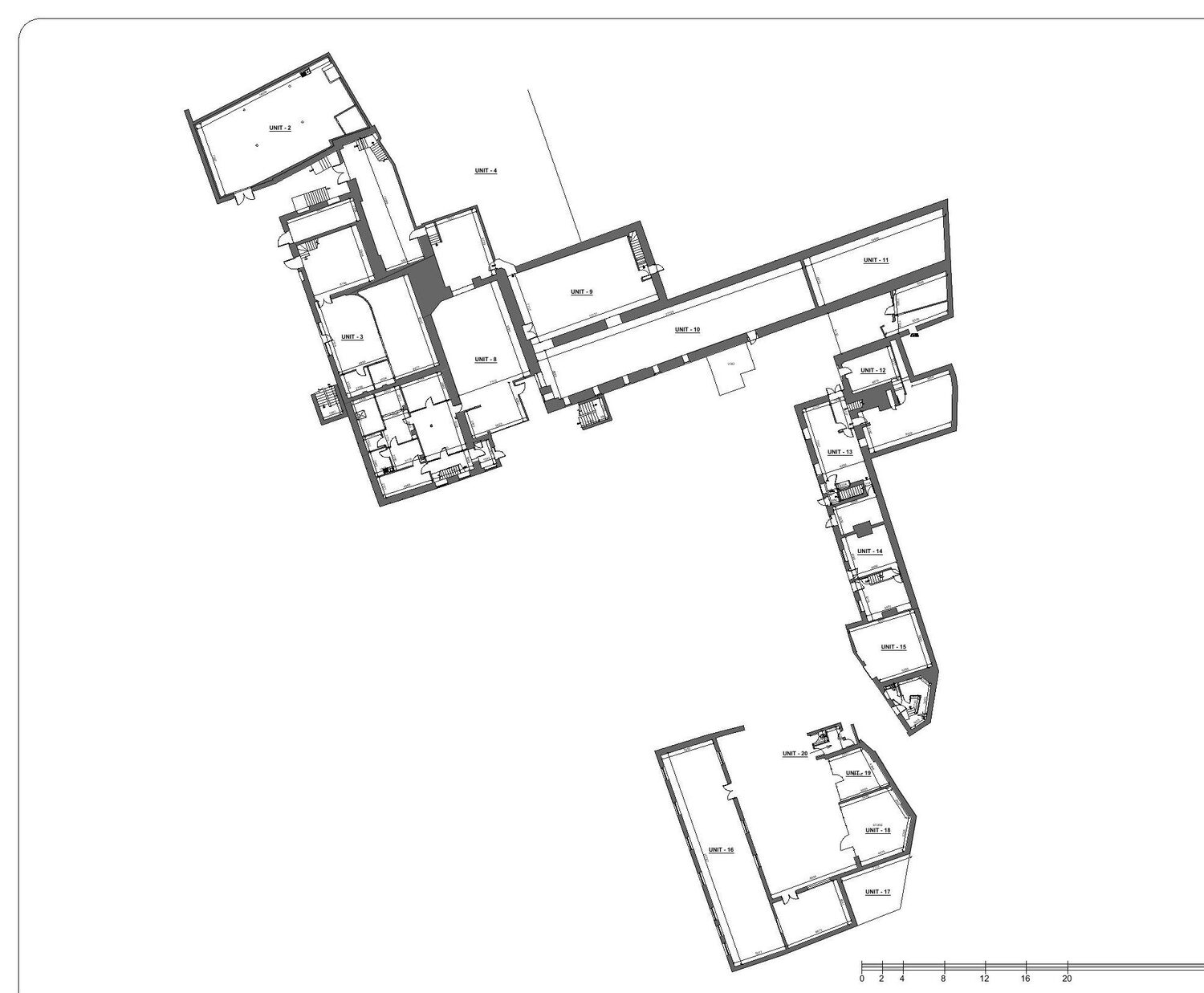
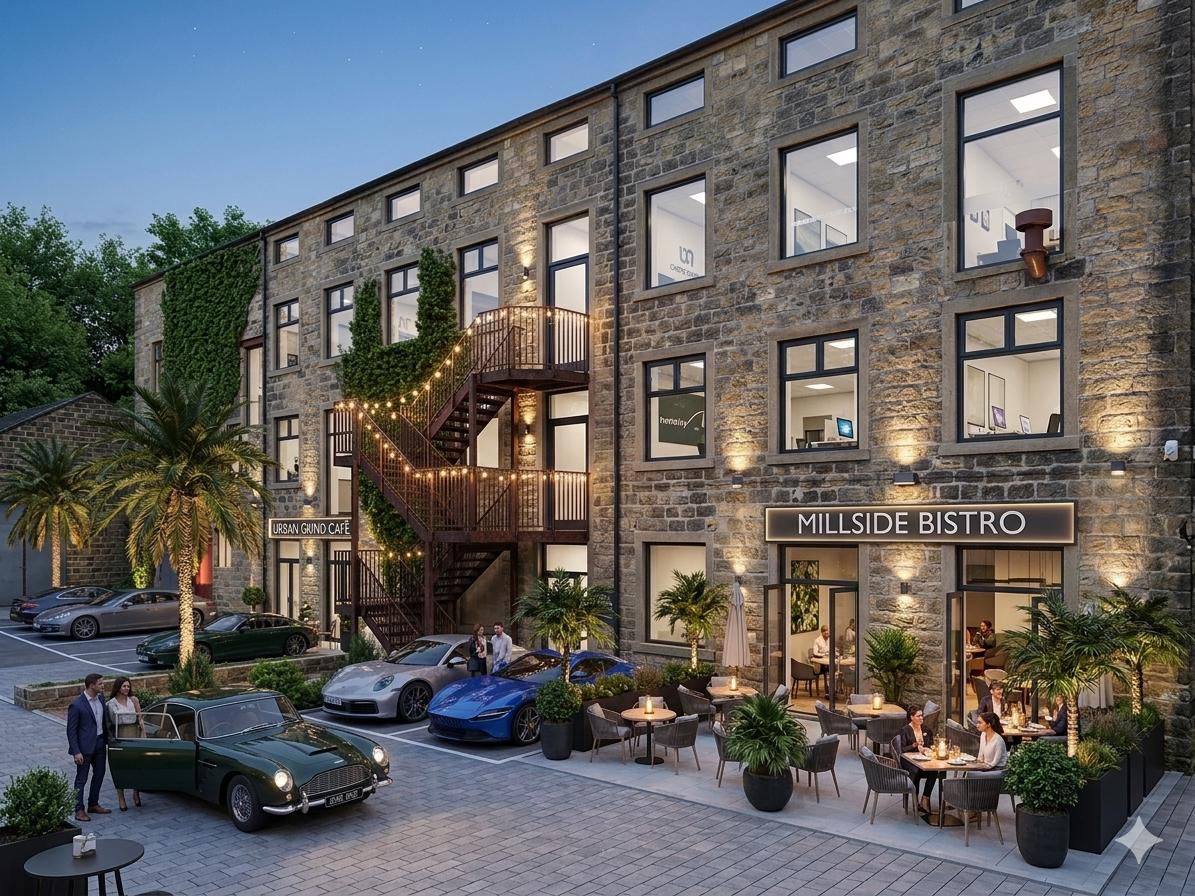
Milling has taken place here since medieval times, on land that formed part of the estate of Kirkstall Abbey. The monks built the goit — the leat that still runs through the site — to power their corn mill. After the 1799 fire, the complex was rebuilt from the 1820s in coursed squared gritstone under grey slate and stone-slate roofs, arranged as four linked ranges in a rough L-plan with a masonry platform and a bridge carrying the buildings over the goit.
2A working mill
Historic England's list description records the complex by its original industrial functions — a corn-mill range, the tall western range, a former drying house and finishing shops for the woollen manufacture, and the remains of machine shops and stables. From the 1820s until 1961 the site produced corn, oil and woollen cloth; thereafter it was let as light-industrial units. The statutory entry reads: "Mill complex, corn/oil and wool, now light industrial units."
3Heritage protection
Abbey Mills is Grade II listed (first listed 1976, amended 1996) and carries a group-value designation reflecting its place in the Kirkstall Abbey precinct, beside the Grade I listed Abbey itself. Listing protects the whole building, inside and out. The site is not within a conservation area and has no Tree Preservation Orders — but the listed-building controls remain the governing constraint, guiding a careful, conservation-led restoration.
4Restoration approach
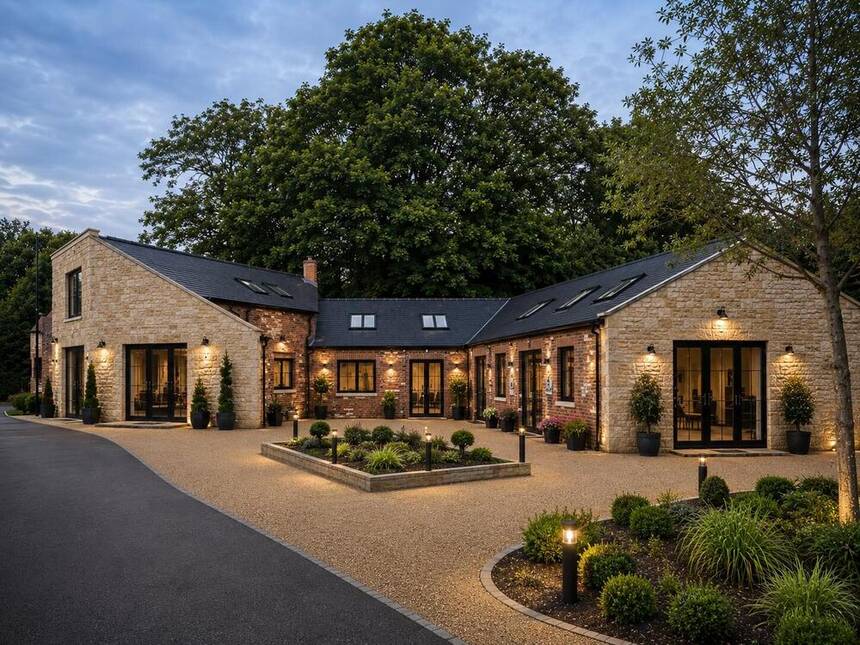
The works are sequenced around the building's significance, concentrating early repairs in the lower-significance areas. A meaningful first phase of consent-free repair — removing modern boarding, repairing and re-glazing the historic windows like-for-like, fixing roofs and rainwater goods in matching materials, and stripping out modern fit-out — arrests decay, with Listed Building Consent reserved for later alteration works. The character is kept as the feature, not hidden away.
5Use & flexibility
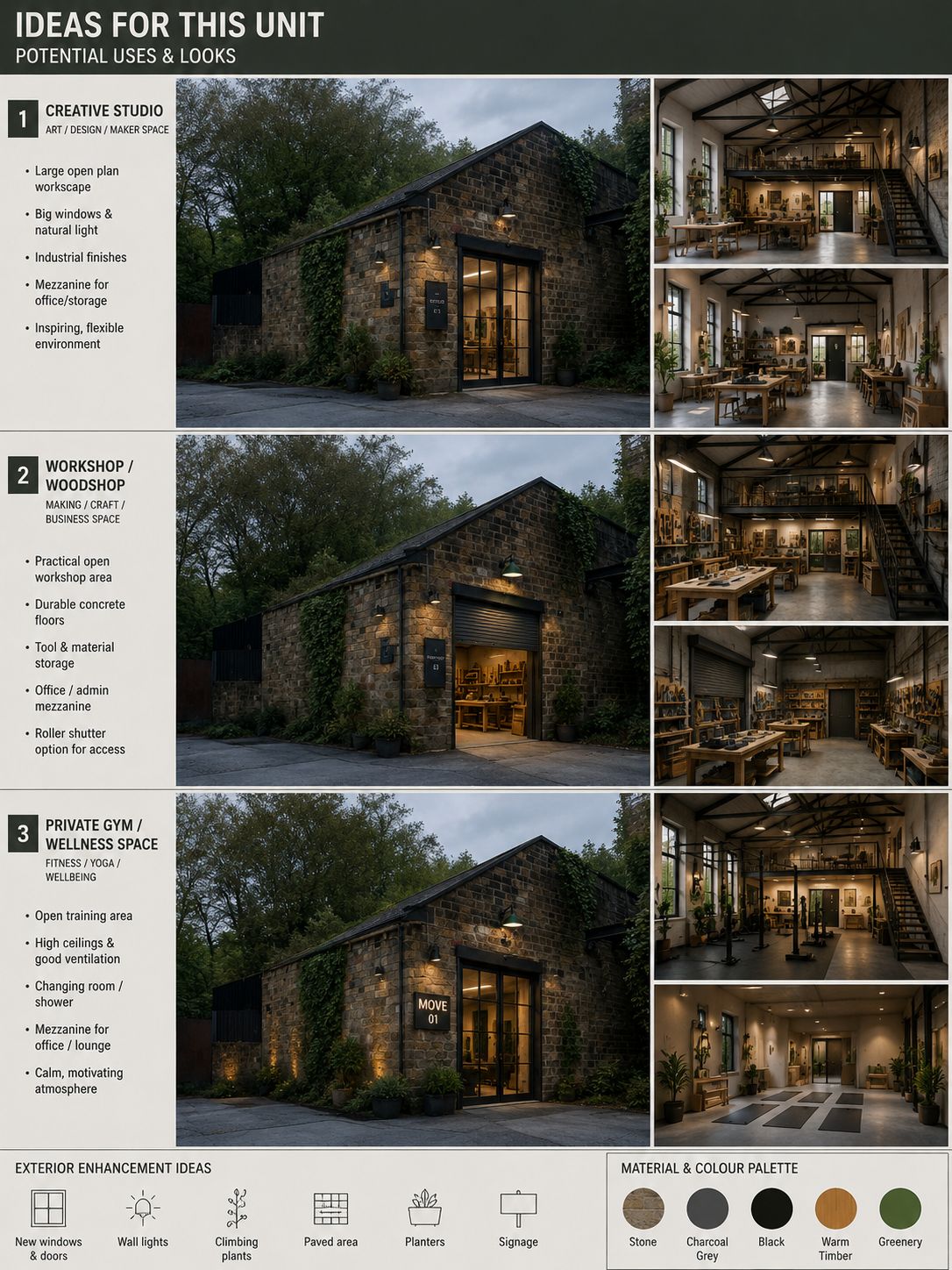
Returning Abbey Mills to offices and light-industrial workshops resumes its established lawful use, and those uses now sit within a single planning class (Class E). In practice that means a unit can be used as offices, studios, R&D, light-industrial workshop, shop, café/restaurant, gym, clinic or nursery — and move between them — without a planning application. Rare flexibility for a building of this character.
6The setting
The mill sits in a green, historic pocket of Leeds on the River Aire, immediately beside Kirkstall Abbey and Abbey House Museum — a genuine destination. The A65 links the site to Leeds city centre (about two miles) and the wider motorway network, with rail at Burley Park and Kirkstall Forge nearby.